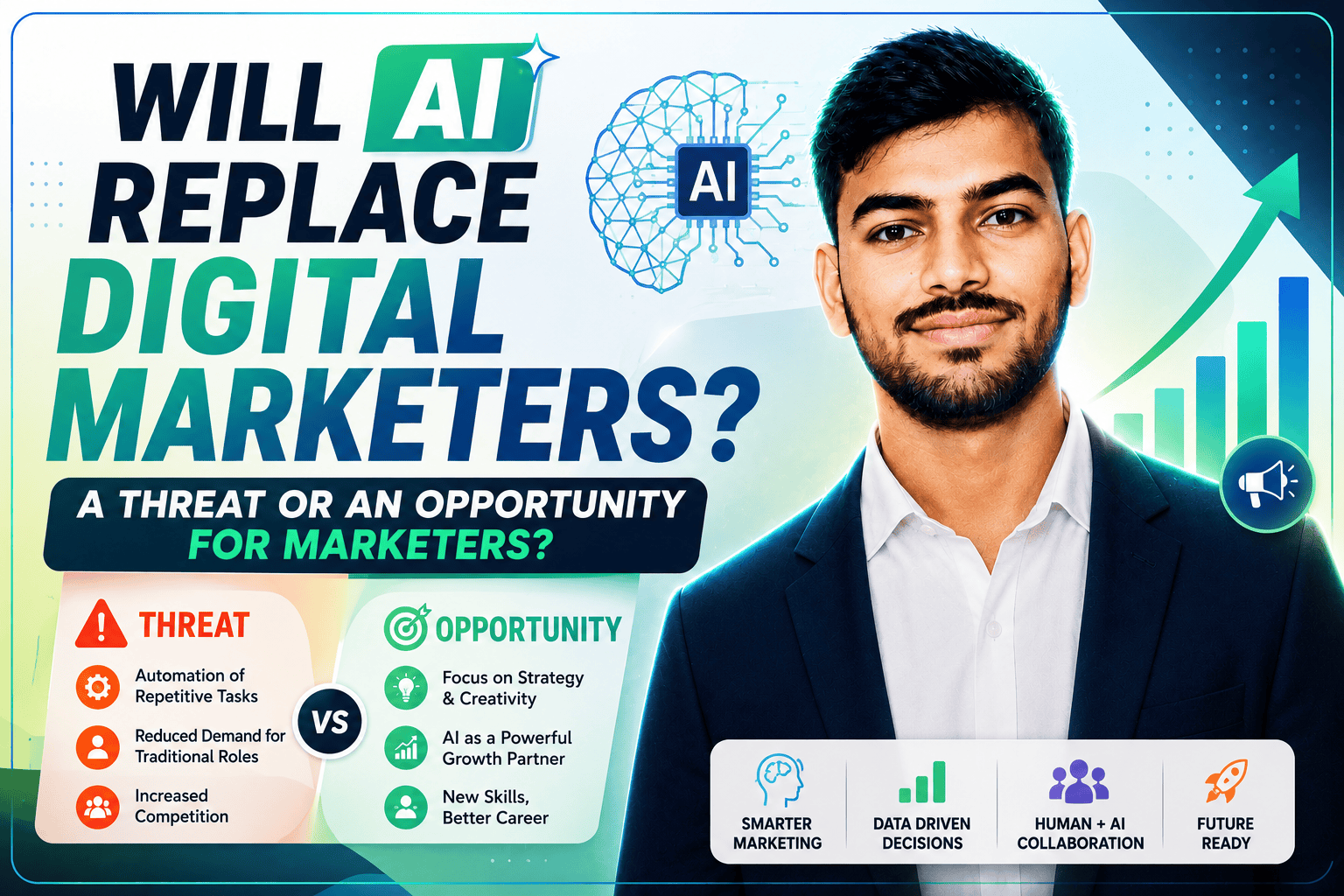
Artificial Intelligence has changed the way businesses create content, run ads, study customers, and measure results. Many marketers now use AI to complete work that once took hours. This change creates one important question: Will AI replace digital marketers?
The short answer is no, but AI will change digital marketing jobs significantly. AI can handle many repetitive tasks, but marketers still need to understand customers, build strategies, make decisions, manage brands, and connect marketing activities with business goals.
Recent marketing research supports this shift. The Content Marketing Institute found that only 4% of surveyed marketers expected AI to fully replace them, while 53% believed AI would augment their existing roles. So, the real question is not whether AI will replace every digital marketer. The better question is: Which marketing tasks will AI automate, and which skills will become more valuable?
What Does Will AI Replace Digital Marketers? Actually Mean?
AI replacing digital marketers does not necessarily mean that every marketing job will disappear.
Digital marketing includes many different activities:
- SEO
- Content marketing
- Social media marketing
- Paid advertising
- Email marketing
- Analytics
- Branding
- Conversion optimization
- Marketing strategy
- Customer research
- Lead generation
- Client management
AI can automate parts of many of these activities. However, a complete marketing role usually requires several skills at the same time.
For example, AI can create ten ad variations quickly. But a marketer still needs to decide:
- Which audience should see the ads?
- What problem does the product solve?
- Which offer should the business promote?
- How much should the company spend?
- Which campaign deserves more budget?
- Why did customers stop converting?
- How should the brand respond to negative feedback?
This difference separates task automation from job replacement.
Current research also shows that AI has not caused widespread job replacement across marketing. CMI reported that only 11% of surveyed organizations had replaced workers with AI, although entry-level hiring has become more difficult.
How Is AI Changing Digital Marketing Today?
AI already performs many marketing tasks faster than humans.
Marketers now use AI for:
| Digital Marketing Task | How AI Helps |
|---|---|
| Content Writing | Creates drafts, outlines and variations |
| SEO | Finds topics, keywords and content opportunities |
| Social Media | Creates captions and content ideas |
| Paid Ads | Generates ad variations and supports optimization |
| Email Marketing | Creates subject lines and email drafts |
| Analytics | Finds patterns in large datasets |
| Customer Research | Summarizes reviews and customer feedback |
| Personalization | Creates different content for audience groups |
| Reporting | Summarizes campaign performance |
| Automation | Connects repetitive marketing activities |
AI therefore saves time and reduces manual work. The HubSpot State of AI research found that 66% of marketers globally were already using AI in their roles in its 2025 research. This means AI is no longer something marketers can simply ignore.
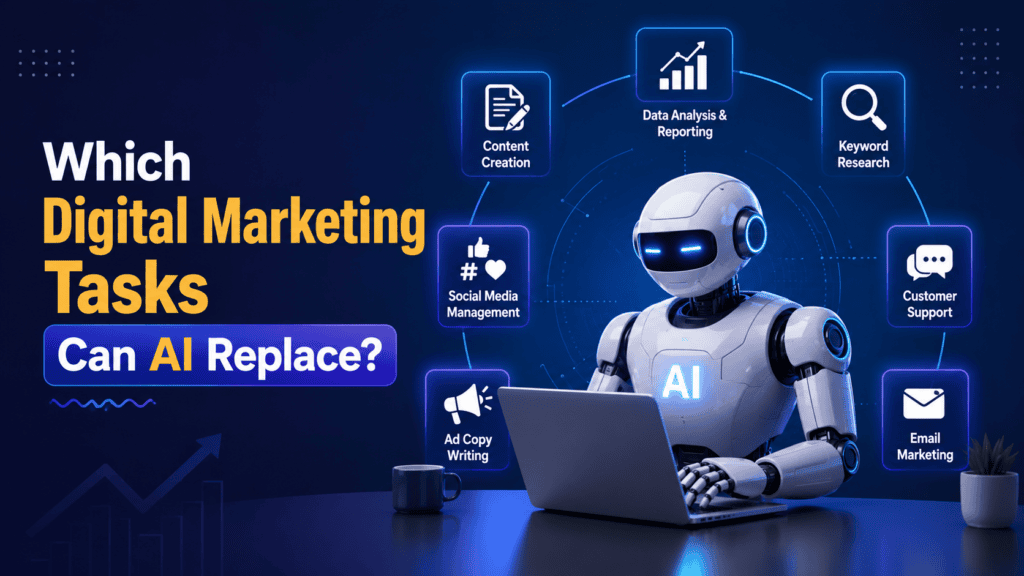
Which Digital Marketing Tasks Can AI Replace?
AI can replace or greatly reduce some repetitive marketing tasks. These tasks usually follow clear patterns and require less human judgment.
1. Basic Content Drafting
AI can create first drafts for:
- Blog posts
- Social media captions
- Product descriptions
- Email copy
- Ad headlines
- Meta descriptions
However, marketers still need to review the content for accuracy, brand voice, originality, and usefulness.
2. Basic Reporting
AI can quickly summarize:
- Website traffic
- Conversion rates
- Ad performance
- Engagement
- Search performance
- Customer behavior
Instead of spending hours preparing reports, marketers can spend more time understanding what the numbers mean.
3. Repetitive Social Media Work
AI tools can help create captions, suggest content ideas, repurpose posts, and organize publishing schedules. This reduces the amount of manual work involved in social media management.
4. Basic Ad Variations
AI can generate multiple headlines, descriptions, creative ideas, and audience variations. Platforms such as Google and Meta also use automation to optimize advertising campaigns.
5. Simple Data Analysis
AI can identify patterns in large datasets much faster than a person can manually review every row. But marketers still need to decide what action the business should take based on those findings.
Which Digital Marketing Skills Can AI Not Easily Replace?
This is where human marketers continue to have an advantage.
Strategic Thinking
A business needs more than content and advertisements. It needs a clear marketing direction.
A marketer can connect:
Business Goal → Audience → Positioning → Offer → Channel → Campaign → Measurement
AI can support this process, but humans still need to make important business decisions.
Customer Understanding
Customers do not always behave according to data. A marketer can speak with customers, understand their frustrations, notice emotional triggers, and identify problems that numbers alone may not reveal.
Creativity
AI can generate many ideas, but marketers need to decide which idea fits the brand.
Strong marketing often depends on:
- Original concepts
- Cultural understanding
- Emotional storytelling
- Brand personality
- Timing
- Context
Communication
Digital marketers often work with:
- Clients
- Business owners
- Designers
- Sales teams
- Developers
- Content teams
AI cannot replace the trust and communication that people build with other people.
Decision-Making
Marketing involves uncertainty.
A marketer may need to decide whether to:
- Increase ad spending
- Change the target audience
- Stop a campaign
- Change the offer
- Enter a new market
- Reposition a product
These decisions require business judgment.
AI Vs Digital Marketing: Which One Is Better?
The comparison should not be AI versus digital marketing. AI works best as a part of digital marketing.
| Area | AI | Human Digital Marketer |
| Speed | Excellent | Moderate |
| Repetitive Work | Excellent | Limited |
| Data Processing | Excellent | Moderate |
| Content Drafting | Excellent | Excellent |
| Strategy | Limited | Excellent |
| Customer Relationships | Limited | Excellent |
| Brand Understanding | Limited | Excellent |
| Creativity | Good for ideas | Strong for direction |
| Business Judgment | Limited | Excellent |
| Communication | Limited | Excellent |
| Large-Scale Personalization | Excellent | Moderate |
| Final Responsibility | No | Yes |
The strongest approach combines both. AI provides speed and scale. Marketers provide direction and judgment. LinkedIn’s marketing research also describes AI as an opportunity to support marketers rather than simply replace them, particularly in areas such as editing, analytics, campaign optimization, and content creation.
Will AI Replace Digital Marketers by 2030?
AI will probably replace some marketing tasks by 2030, but a complete replacement of digital marketers looks unlikely. The marketing profession will probably change in three major ways.
More Automation
Marketers will spend less time on repetitive execution.
AI will handle more:
- Research
- Reporting
- Content variations
- Data analysis
- Campaign testing
- Personalization
- Workflow automation
Higher Expectations
Businesses may expect one marketer to accomplish more because AI can increase productivity. A marketer who once managed five campaigns manually may eventually manage many more campaigns with AI assistance.
More Strategic Roles
Companies will need people who can manage AI-powered marketing systems and connect them to business goals.
Future roles may include:
- AI Marketing Specialist
- Marketing Automation Manager
- AI Content Strategist
- Performance Marketing Specialist
- Marketing Data Analyst
- Growth Strategist
- AI SEO Specialist
- Marketing Operations Manager
A 2026 CIM-related report found that 19% of marketers expected companies to reduce headcount because of AI automation, Just Like Growth Wealthh. while many organizations also reported an AI skills gap. This shows why marketers need to develop new skills instead of waiting for the technology to settle.
Need Any AI Related Consultation : Visit Growth Wealthh
Will AI Take Over Digital Marketing Jobs?
AI will affect different marketing jobs differently.
| Job Area | AI Impact | Future Outlook |
| Basic Content Writing | High | Needs stronger strategy |
| Basic Social Media Scheduling | High | Automation will increase |
| Basic Reporting | High | AI can handle much of the work |
| SEO Research | Medium-High | Human strategy remains important |
| Paid Advertising | Medium-High | AI will automate more optimization |
| Email Marketing | Medium | Strategy and segmentation remain important |
| Content Strategy | Medium | Human direction remains valuable |
| Brand Strategy | Low-Medium | Human judgment remains important |
| Marketing Analytics | Medium | AI improves analysis |
| Client Management | Low | Human communication remains important |
| Creative Direction | Low-Medium | Human ideas and judgment remain valuable |
| Marketing Leadership | Low | Business decisions require human responsibility |
The biggest risk does not come from AI alone. The bigger risk comes from not learning how to use AI.
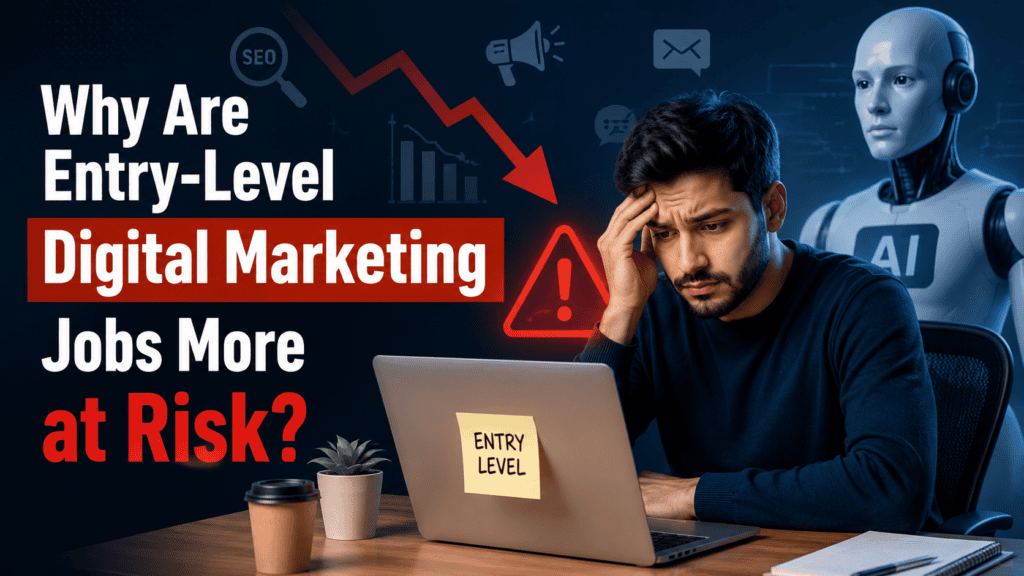
Why Are Entry-Level Digital Marketing Jobs More at Risk?
Entry-level marketing jobs often include repetitive activities.
For example, a junior marketer may spend time:
- Creating basic reports
- Finding keywords
- Writing simple captions
- Creating content drafts
- Scheduling posts
- Collecting data
- Making basic ad variations
AI can perform many of these activities quickly. This can reduce the number of people companies need for purely execution-based work. CMI’s 2026 research reported weaker entry-level hiring while experienced marketers continued to see stronger demand. Therefore, beginners should not focus only on learning tools. They should learn why marketing decisions work.
What Skills Should Digital Marketers Learn Before 2030?
Digital marketers can prepare for the future by combining marketing knowledge with AI skills.
1. Learn AI Tools
Understand how to use AI for:
- Research
- Content
- SEO
- Analytics
- Advertising
- Automation
- Customer insights
2. Improve Analytical Skills
Learn how to understand:
- Conversion rate
- Customer acquisition cost
- Return on ad spend
- Traffic sources
- Engagement
- Revenue
- Customer lifetime value
Numbers help marketers make better decisions.
3. Learn Marketing Strategy
Understand the complete customer journey:
Awareness → Interest → Consideration → Conversion → Retention
This skill becomes more valuable when AI handles execution.
4. Develop Creative Thinking
Do not depend on AI for every idea.
Build your ability to create:
- Campaign concepts
- Brand stories
- Offers
- Content angles
- Unique positioning
5. Learn Automation
A modern marketer should understand how different tools work together.
For example:
Lead Form → CRM → AI Qualification → Email → Follow-Up → Sales Team
Automation can help one marketer manage a much larger workflow.
6. Understand Customers
- Talk to customers.
- Read reviews.
- Study questions.
- Understand objections.
- The better you understand people, the better you can direct AI.
Is AI a Threat or an Opportunity for Digital Marketers?
AI can be both. It becomes a threat when a marketer only offers repetitive execution. It becomes an opportunity when a marketer uses AI to increase productivity and focus on higher-value work.
Consider two marketers.
- Marketer A:
- Writes every article manually
- Creates every report manually
- Performs repetitive research
- Schedules everything manually
- Avoids AI tools
- Marketer B:
- Uses AI for research
- Automates reports
- Uses AI for content drafts
- Studies campaign data
- Focuses on strategy
- Talks directly with customers
- Measures business results
Marketer B can usually complete more valuable work in less time. That is the real shift happening in digital marketing.
How Can Digital Marketers Use AI Without Losing Their Value?
The best approach is simple:
Do not compete with AI. Manage it.
Use AI for the tasks it performs well.
Then spend your time on tasks that require human judgment.
A practical workflow can look like this:
- Define the business goal.
- Research the target audience.
- Use AI to collect and organize information.
- Create the marketing strategy.
- Use AI to generate initial content ideas.
- Review and improve the content.
- Launch the campaign.
- Use AI to analyze performance.
- Make human decisions based on the data.
- Test and improve the campaign.
This approach makes the marketer more productive instead of making the marketer unnecessary.
What Does the Future of Digital Marketing Look Like?
Digital marketing will likely become more automated, personalized, and data-driven. AI will handle more background work.
Marketers will focus more on:
- Strategy
- Customer experience
- Brand building
- Creative direction
- Business growth
- Data interpretation
- Marketing leadership
The role will change from “person who executes marketing tasks” to “person who directs marketing systems.” That difference will matter greatly by 2030.
What Should Beginners Do If They Want a Career in Digital Marketing?
Beginners should not avoid digital marketing because of AI. Instead, they should learn digital marketing and AI together.
A useful learning path includes:
| Stage | What to Learn |
| Step 1 | Digital marketing fundamentals |
| Step 2 | SEO and content marketing |
| Step 3 | Social media marketing |
| Step 4 | Google and Meta advertising |
| Step 5 | Analytics |
| Step 6 | AI marketing tools |
| Step 7 | Marketing automation |
| Step 8 | Strategy and customer research |
| Step 9 | Real projects |
| Step 10 | Portfolio building |
Do not try to learn every AI tool. Focus on understanding how to solve marketing problems. Tools will continue to change, but marketing fundamentals will remain useful.
What Is the Biggest Lesson From AI Vs Digital Marketing?
The biggest lesson is that AI does not understand business in exactly the same way humans do.
- AI can process information.
- Marketers need to decide what the information means for the business.
- AI can create content.
- Marketers need to decide what the audience actually needs.
- AI can analyze campaigns.
- Marketers need to decide what action to take.
- AI can generate hundreds of ideas.
- Marketers need to choose the idea worth pursuing.
- That is why the future will not simply belong to AI.
It will belong to marketers who know how to work with AI.
Will AI Replace Digital Marketers Completely?
No, AI is unlikely to replace digital marketers completely.
However, AI will replace some repetitive marketing tasks and change the skills companies expect from marketers.
The future marketer will need a combination of:
- Marketing knowledge
- AI skills
- Data analysis
- Creativity
- Strategy
- Communication
- Customer understanding
- Business thinking
The current evidence points toward job transformation rather than complete job elimination. CMI found that only 4% of marketers expected AI to fully replace them, while 53% expected AI to augment their roles. The message for marketers is simple: Do not try to compete with AI on speed. Use AI to improve your speed and compete on strategy, creativity, judgment, and customer understanding.
Final Thoughts
So, will AI replace digital marketers?
- AI will replace some repetitive tasks. It may reduce demand for certain execution-only roles. It will also change how marketing teams hire, measure productivity, and organize their work.
- But digital marketing involves much more than producing content or analyzing numbers.
- Businesses still need people who understand customers, create strategies, build brands, make decisions, manage campaigns, and take responsibility for results.
- Therefore, AI is not simply a threat to digital marketers. It is an opportunity for marketers who adapt.
- The marketers most likely to succeed by 2030 will not be those who avoid AI.
They will be the people who know how to combine AI’s speed with human creativity, strategy, and judgment.
Frequently Asked Questions
No. AI will automate many repetitive marketing tasks, but marketers will continue to handle strategy, creativity, customer understanding, communication, and business decisions.
AI may reduce some execution-based jobs, especially roles focused on repetitive tasks. However, strategy-led and AI-enabled marketing roles should remain important.
AI will likely automate more marketing activities by 2030, but complete replacement of digital marketers is unlikely. Marketing roles will evolve toward strategy, analysis, creativity, and AI management.
Yes. Digital marketing remains valuable, but professionals need to learn AI tools, analytics, strategy, automation, and customer research.
Basic content creation, repetitive reporting, simple social media scheduling, basic research, and other execution-heavy tasks face higher automation risk.
Strategy, brand management, creative direction, client management, marketing leadership, customer research, and roles that require strong business judgment are harder to automate completely.
Yes. AI skills can help marketers work faster, analyze information, automate repetitive tasks, and create more effective campaigns.
AI can support keyword research, content planning, analysis, and optimization. However, strong SEO still requires strategy, technical understanding, quality control, user intent analysis, and business knowledge.
AI is better at speed, data processing, repetitive work, and producing variations. Humans remain stronger at strategy, relationships, context, creativity, and complex decisions.
Learn digital marketing fundamentals first, then add AI tools, analytics, automation, customer research, creative thinking, and strategy. The goal should be to become an AI-enabled marketer rather than an AI-dependent marketer.